
When in a small town, the easiest way to get out into the countryside cheaply is to rent a bike. This is apparent in Filandia, a small village in the Coffee Highlands of Colombia. As motorbikes were unavailable, myself and three others from the hostel decided we would bike out into the countryside to visit another small town and a finca (rural estate). Naturally, the quality of the bikes were top class – 10 speed bikes that were constructed before I was born. But, for the low low price of 5000 COP, about 2 USD, shoddiness was worth the investment. We set out – a fellow American, French, and a Canadian who looked like Zinedine Zidane. Zizou was not impressed with the quality. Mon dieu.

We set off, wheels against the cobblestones, speeding downhill until an impasse pulled off to the side. The other American, who had previously visited the finca, directed us off to the right. This route was again downhill, but instead of being somewhat paved, was entirely filled with rocks. The road made American highways look perfect.
Due to not needing to pedal as much, I switched gears from the initial adjustment. However, something went wrong. The pedals jammed every up and downshift, and then released. The bike continued to move, so I thought nothing of it. After around a half hour of careening around switchbacks and the brakes threatening to give, we reached the first stop. Bidea Hostel, our accommodation, was building an extension in the countryside. This version would be smaller, albeit steeped in nature, truly providing an escape from the almost non-existent congestion in Filandia. Due to construction not being finished, we lounged around the hostel, playing chess and admiring the beauty.
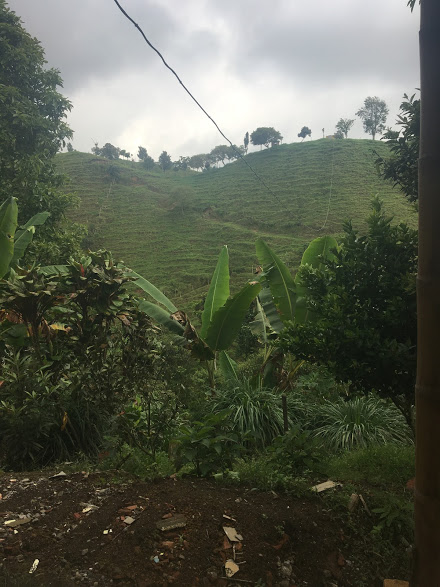
The supervisor told us that there was a viewpoint across the way, and could be reached with a brief hike. To our feigned surprised, a path didn’t really exist. People had trodden the hills beforehand, but anything concrete was not there. We ferried a river with the help of three strategically-placed bamboo poles and continued through mud-covered holes until the top was reached. This allowed for a lookout on the rest of the countryside as well as a view towards our final destination. Tripping, slipping, and falling on the loop back, we made it downhill back to the finca for a short break before carrying on.

Our target, a nearby village named Ulloa was only a forty minute ride over the bumps and gravel. Needless to say, my bike could not handle the road and after an uphill venture, decided to give out. Of course, this happened when the others were ahead. GRRRRRRR ROUROUROUROU. Three dogs suddenly jumped out! I yelped in shock and positioned the defective bike as a barrier in between my pasty skin and their teeth. The owners came running out. “You don’t like dogs?” asked one, puzzled. Well, when the chain gives and I can’t move, it’s scary. I offered my hand and pets to the dogs who came close, sniffed, jumped back, and began to bark again. The other man took a look at the bike, snapped the chain back into place, and shooed the dogs inside. They wished me a safe trip, saying the village was only another thirty minutes away. I carried on, confident that the bike would hold.
CRACK. Another uphill try and the chain again came loose. Zizou bent down, looked, and determined that one of the screws that held the chain in place was broken. Only a replacement of the part would solve the issue. When the chain circled through it’s motion, the broken link would create friction and cause the chain to fall off. As a result, further damage would likely occur if I kept pushing it on hills. Downhill or flat portions were fine, but any uphill gradient would need to be walked. No sense in complaining. Onwards. Fortunately, the bike was light.
They pushed on, graciously slowing down so that we connected in certain parts. After what seemed like an hour, we finally arrived at Ulloa, myself more sweat-drenched than the others. It would be impossible to ride back uphill without risking further damage, so we elected to pay for transport back. After lunch, naturally.
No other tourists were in sight. We stopped at a restaurant in the main square, offering lunch combos for 7000 COP – a steal. The other American wasn’t partial to eating to meat, so she asked the server if the offerings could be served without meat. The server gave a brusque “NO” before turning to us and asking politely what we would have. Lunch was a glass of some local fruit juice, tripe soup, and a mixed plate of salad, skirt steak, beans, rice and plantains. Pretty similar to the majority of meals offered in Latin America. Despite removing the main protein, due to there being no vegetarian options for the other American, she was charged the full price, same as us. After a few dramatic diatribes, we decided it wasn’t worth the time and effort, paid, and got up to look for transit.
In Filandia, the most common form of shared transit are Willys, or Jeeps. They’re similar to Songthaews in Thailand, but with space for people to stand on the back and hold the roof rack. As the jeeps only leave when full, anyone with a smaller party has to pay the difference if they want to leave. The first driver quoted 40000 COP – not extravagant, but more than we were willing to pay. We decided to walk around, bikes out front, to explore other options. (Thanks Destination Addict!)

Standing in a porch off to the side of the square, a man came over and asked if we spoke “Colombian”. The dialect there is easy to understand for a hispanofone, so it was funny to hear the language being called by a different name. He asked where we were going. We relayed Filandia, and told him that the Willys would cost 40000 COP. He shook his head, disgruntled. “They’re trying to rip tourists off. The Willy should cost no more than 20000 and the bikes go on top, not in the seating area. Let me see what I can do.” He whistles for a friend, who pulls over in none other than a Tuk-Tuk. Yes, the famous Thai Tuk-Tuk. In rural Colombia. We all thought it hilarious, this little three wheeler to haul us and our bikes up the steep roads.

The driver quoted 20000 COP for the return leg. We decided that it was our best option and he seemed friendly enough. Zizou and myself lashed the three bikes on top of each other on the roof with bungee cords and set off. The entire ride back, stories were swapped and the driver talked about his upbringing, this new Tuk-Tuk, his family, and wanting to move to a different city for work. After an hour or so in transit, we returned to the outskirts of Filandia. He mentioned that although the police wouldn’t care, traffic control could take his license if we went further in town. No problem. The other two raced back as I walked the bike up and down the length of the town, back to the hostel. As luck would have it, rain started to drench the town minutes after arrival. Now that truly would have been a vicious cycle – walking a broken bike up hills in the pouring rain. Everyone dry and safe, we collapsed into the common room, off to embark upon a well-deserved nap.
 Dispatches by Alec